
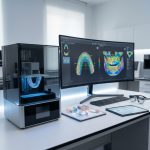
As we have already mentioned with our team, new innovations in dental technology are constantly evolving. Furthermore, they go hand in hand with modern technologies. Consequently, this affects the machines that the industry itself uses. It also influences the procedures for creating dental products. Moreover, work processes and ways of exchanging information are rapidly changing.
Innovations in dental technology in recent years
Dental technicians and dentists now exchange information through software, preventing data loss. At the same time, 3D printing serves as the dental technicians’ best assistant. Additionally, computer-aided design allows professionals to create crowns and bridges with high precision. This happens through modern digital technologies. Today, the production of dental models takes much less time than years ago. Consequently, products such as temporary crowns and dentures require fewer appointments with the patient. As a result, costs drop significantly, and care becomes more precise. Furthermore, specialized software accurately determines the color of the product. Professionals exchange all information digitally to guarantee its preservation.
3D printing
One of the biggest innovations in dental technology in recent years is perhaps three-dimensional printing. It brings numerous advantages. One of the main benefits when creating products is that it saves valuable time for the dental technician. For this reason, many laboratories widely accept the technology. While building a precise product used to take days, today technicians can completely finish it in just a few hours.
SLA Printers
Liquid resin printers work using a laser beam. The beam passes through the print area and cures the material in specific areas. Additionally, SLA printers have some of the most accurate and best finishes. Changing materials is easy and requires no special skills. Furthermore, SLA printers offer a small footprint, an easy process, and an affordable price. Therefore, this makes them very suitable for dental laboratories.
Digital Light Processing (DLP)
Digital Light Processing works on the same principle as SLA. However, the difference is that it uses a digital projector for curing instead of a laser. DLP printers have a small footprint and a simplified workflow. They offer many material options, but their price is higher than SLA printers.
Digital impressions
CAD/CAM systems in dental technology represent integrated technologies. They serve for the digital design and manufacture of dental prostheses, crowns, and bridges. Moreover, they change traditional methods in dental technology by offering greater precision, speed, and predictability of results.
Professionals use CAD technology for the digital design of dental restorations. With CAD systems, 3D software creates virtual models of the necessary structures. Subsequently, CAM technology controls the machines that mill the restorative structures from various materials such as zirconia, ceramics, metal, or resin. However, the main disadvantage of CAD/CAM systems is that they cost a lot, so businesses treat them as a long-term investment.

Biomaterials and regenerative dentistry
New restoration materials are emerging in dentistry. For example, composites mimic the natural structure and strength of teeth. Because they are more durable and aesthetic, dentists frequently use them for tooth restoration. Additionally, researchers are actively working in the field of regenerative medicine. Scientists are developing the regeneration of dental tissues through stem cells and biomimetic methods.
Improved methods in dentistry
Dentists increasingly use laser technologies in surgery, caries treatment, teeth whitening, and periodontal procedures. Lasers allow for minimally invasive procedures, resulting in faster patient recovery and less pain. Furthermore, with the help of technology, digital planning, and simulation, dentists perform more precise and safer implant procedures. Basal implantology allows specialists to place implants in patients with reduced bone density. Moreover, they do this without needing additional bone grafting surgeries. The goal of all procedures is to minimize invasiveness. Ultimately, new technologies and materials allow for less invasive procedures with longer-lasting results and a lower risk of complications.
Trends and innovations in 2026
In 2026, we observe how professionals are actively applying the new innovations in dental technology. Until recently, these ideas were just a bold concept for daily practice. Today, digitalization is entering the era of artificial intelligence and smart materials.
Artificial Intelligence (AI) in design and diagnostics
AI is already an integral part of dental laboratory software. Machine learning algorithms fully automate the CAD design process. For instance, they generate anatomical shapes of crowns in seconds using large databases. In the clinics, AI assists diagnostics by analyzing 3D scans. Specifically, it detects microscopic cracks and cavities with exceptional precision.
Augmented Reality (AR) and 4D printing
Augmented reality is entering en masse through specialized smart glasses. Dentists see a projected 3D model of the jaw directly on the working field. Meanwhile, laboratories are implementing “4D printing” with smart biomaterials. These materials change their properties after a specialist places them in the mouth. Because they respond to body temperature and chewing pressure, they provide unsurpassed comfort.
Information exchange
Besides modernizing processes, these innovations in dental technology change communication. Specifically, they facilitate the exchange of information between a dental technician and a dentist. Software simplifies product creation and data exchange as much as possible. Consequently, the processes become significantly faster. Modern platforms now include AI modules that predict laboratory workload. AMOSYS is the first dental laboratory software in Bulgaria. Through it, users send order information in less than a minute. With the “Dental Order Management Software” you can:
- Send online order data from dentists to dental technicians
- Track order history, amounts paid so far, discounts applied, and delivery times
- View all orders in one place on an interactive dashboard
- Upload photos, STL files, and videos to each order
- Attach notes and real-time chat to each order to clarify details
- Filter orders by various criteria
- Issue invoices, credit and debit notes for the orders
With the AMOSYS software, dental laboratories can manage up to 30 orders per month for free after registering at www.amosys.eu.
Conclusion
New innovations in dental technology give a huge boost to development in dentistry as well. Nowadays, achieving excellent results takes much less time. Specialized software makes workflows smooth, clear, and accurate. Consequently, opportunities are improving for both specialists and patients. Ultimately, satisfied patients are the most accurate measure of the quality of work.
Sources:
- 27.09.2022. AMOSYS. Latest innovations and challenges in dental laboratory;
- Analysis of dental technology trends by 2026